



The Monday After • Apr 20, 2026
Self Talk
 Darren Carlson
About ten years ago, a friend of mine who happens to be a therapist asked me a question I wasn't expecting: "What's the recording playing inside your head?"
I was initially put off by it. It felt like psychobabble, and I was skeptical. But the question stayed with me.
All of us engage in constant self-talk. We ask ourselves questions, reason through decisions, encourage or accuse ourselves. You might hear something like: Stop it. Good job. Why did you do that? Why am I so stupid? Maybe you're your own biggest cheerleader, applauding every thought you have and quietly convinced you're the smartest person in every room. Or maybe you live with a law firm of Condemnation, Guilt, and Shame prosecuting your every waking hour.
Whatever the recording, Psalm 42 speaks directly into it.
The Psalms are unique in all of Scripture. Athanasius, a theologian from the fourth century, observed that "the other Scriptures speak to us, but the Psalms speak for us." The Psalms don't just give us information about God—they train us in honest dialogue with God. They teach us how to bring our full, unfiltered selves before him and trust that he can handle it.
He Isn't Eating. He Isn't Sleeping.
Look at verse 3: "My tears have been my food day and night."
He's not eating. Tears are his only nourishment. And notice he's weeping through the night—which means he isn't sleeping either. This is more than sadness. This is clinical-level depression. The psalmist is physically undone.
Then look at verse 10: "My bones suffer mortal agony as my foes taunt me, saying to me all day long, 'Where is your God?'"
Words are doing this to him. Other people's taunts are causing physical suffering. He is in a full spiral—sleepless nights, no appetite, racing thoughts, and a deep spiritual dryness—and the cruelty of others is landing in his bones.
I want to be honest with you about something. Two years ago, Amy and I were supposed to leave for a three-day retreat where I was scheduled to speak. The night before we left, after months of accumulated pressure from multiple directions, something broke loose. At 1am, then 2am, then 3am, then 4am, I woke up in what I can only describe as a panic attack. I was pacing. I wasn't making sense. I definitely wasn't sleeping. There was no unconfessed sin. The pressure had simply accumulated until my body gave out.
I share that not to dramatize my experience but to normalize yours. Life gets very real, very fast. If you are not currently experiencing the effects of a broken world, you will. As R.E.M. once put it with more theological accuracy than they probably intended: everybody hurts sometimes.
Did He Do Something Wrong?
Here's the question I want you to sit with: Do you think the psalmist sinned his way into this condition?
When we face spiritual dryness, our instinct is almost always to assume we must have done something wrong—that we've missed a step, pulled back from God somehow, or let some unaddressed failure create distance. And so we reach for the checklist: Have I prayed enough? Confessed every sin? Read my Bible consistently? Been sufficiently grateful?
These aren't bad questions. But Psalm 42 resists the idea that spiritual dryness is always the consequence of personal failure. The psalmist doesn't respond to his anguish with a list of corrective spiritual tasks. He doesn't say, "Let me figure out what I did wrong and fix it." Instead, he does something far more demanding: he wrestles. He pours out his anguish to God honestly, without resolution, and keeps returning to him anyway.
Three times in this psalm, he asks himself the same question: "Why, my soul, are you downcast? Why so disturbed within me?" And three times he answers himself with the same command: "Put your hope in God, for I will yet praise him, my Savior and my God."
This is the most sophisticated kind of self-talk—not toxic positivity, not self-condemnation, but the honest acknowledgment of pain held alongside a stubborn, chosen hope.
The Purpose in the Dryness
Perhaps the psalmist is not suffering because he has done something wrong. Perhaps this season of dryness is itself part of what God is doing in him—a refining that can't be shortcut by pulling the right spiritual levers.
Sometimes what God wants most is not our impeccable checklist-keeping. It's our raw, persistent, honest seeking of his face, even when he feels far away. Even when all we can manage is to remind ourselves—put your hope in God—and mean it just enough to say it.
Resist the temptation to explain away your dryness too quickly. Don't assume there's a formula you've missed. The soul that genuinely longs for God, even in confusion and anguish, is already expressing something profound. Your longing is faith. Your tears, like the psalmist's, are not evidence that God has abandoned you. There may be evidence that you are being formed into someone who trusts him more deeply than comfort alone could ever produce.
So let the Psalms train you. Let them give you words when you have none. And when the recording in your head turns accusatory and dark, let the psalmist's stubborn refrain become your own:
Why are you cast down, O my soul? Put your hope in God. I will yet praise him.

On the island of Lesbos, I met a Persian man who had come to that same island five years earlier — not as a visitor, but as a refugee. Upon arrival, he was detained in a prison at the international airport for six months without ever seeing the sun. After his release, he spent another year at a refugee camp in Corinth. Somewhere in that stretch of darkness and waiting, he got his hands on a Bible and became a Christian.
Now he goes back.
He was there the day I met him — in his Virginia Tech shirt, moving through the camp with purpose, serving the very people who reminded him of who he used to be. He never imagined he would willingly walk into a place like that again. But the gospel has a way of turning the places we once hated into the places we feel most called to love.

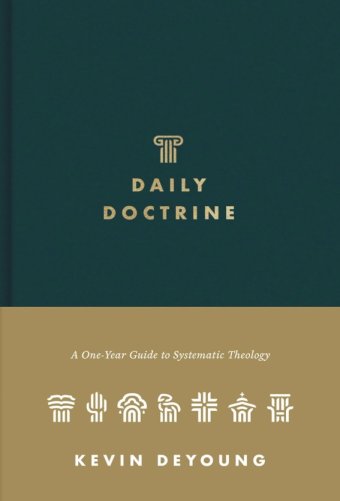 I think everyone would love to understand theology better without having to take a graduate-level class. If that is you, here is a good way to start. Designed to make systematic theology clear and accessible for the everyday Christian, this
devotional
walks through the most important theological topics over the course of a year.
I think everyone would love to understand theology better without having to take a graduate-level class. If that is you, here is a good way to start. Designed to make systematic theology clear and accessible for the everyday Christian, this
devotional
walks through the most important theological topics over the course of a year.
Thanks for checking in.
Sign up here to receive Darren Carlson's The Monday After email. This weekly newsletter is designed to encourage your faith and share inspiring stories of what God is doing around the world. Each edition features a short devotional, a story that will give you a glimpse of His work in unexpected places, and a resource you might find helpful.
8.10.26The People of the Book Who Don't Read
You can read. You've been able to read since you were a small child, so long that you can't remember what it felt like not to. You can't look at a stop sign and not read it. Literacy has rewired your brain. And because you read in English, you've been shaped […]
8.3.26A Non-Anxious Presence
Ecclesiastes 10 is a chapter about how small things ruin big things — dead flies in the perfume, one sinner destroying much good. Qohelet walks through an upside-down world where fools sit in high positions and princes walk like slaves. But before he describes that world, he tells you how to […]
7.27.26Outrage Porn
"As charcoal to embers and as wood to fire, so is a quarrelsome person for kindling strife." — Proverbs 26:21 (NIV) I do this more often than I'd like to admit: I'll come across some argument online — a thread, a controversy, a "this changes everything" post — and it looms […]
7.20.26The Stream
"There is a river whose streams make glad the city of God." (Psalm 46:4) Psalm 46 mentions water twice, and the contrast is the whole point. First, the sea—roaring, swelling, threatening: "though its waters roar and foam and the mountains quake with their surging" (vv. 2–3). The sea is the ancient […]


